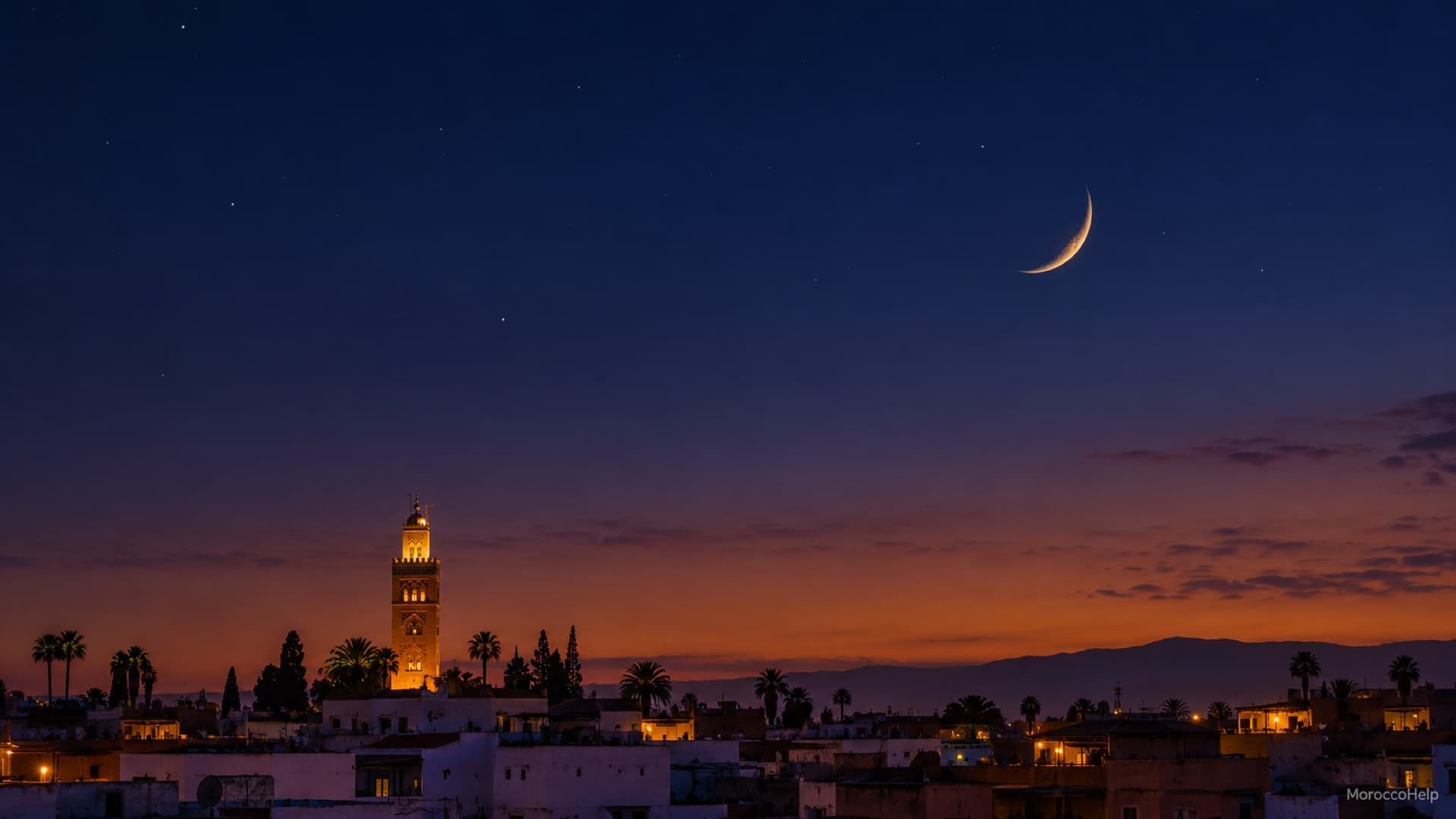
Moon Sighting in Morocco: Why Ramadan and Eid Sometimes Fall a Day After Saudi Arabia
Every year, as Ramadan approaches, the same question appears in Moroccan homes and across the diaspora: Saudi Arabia has announced the start of the month - will Morocco follow? Often the answer is "one day later". This is not an oversight. It follows from a deliberate, centuries-old method of fixing the lunar months by actually observing the crescent (ru'yat al-hilal) from Moroccan territory.
"Fast when you see it, and break the fast when you see it; and if it is obscured from you, then complete the count of Sha'ban thirty days." - (Bukhari & Muslim)
Two different methods
Saudi Arabia fixes its civil Islamic calendar (Umm al-Qura) astronomically, and its Supreme Court confirms the month through its own sighting committees.
Morocco, following the Maliki school's insistence on local sighting (each land has its own horizon - ikhtilaf al-mata li'), waits for the crescent to be actually observed from the Kingdom. The Ministry of Habous and Islamic Affairs coordinates observation after sunset across the country, with regional officials, religious leaders and military observers taking part, and the result is announced the same evening in the name of the King, Commander of the Faithful (Amir al-Mu'minin).
Because the young crescent is frequently too low, faint or geometrically absent over Moroccan skies on the evening the Umm al-Qura month begins, Morocco's month starts - and ends - a day later in many years.
The verified record: 2024–2026
| Event | Saudi Arabia | Morocco | Difference |
|---|---|---|---|
| Ramadan 1445 / 2024 - first day | Mon 11 March | Tue 12 March | +1 day |
| Eid al-Fitr 1445 / 2024 | Wed 10 April | Wed 10 April | same day |
| Eid al-Adha 1445 / 2024 | Sun 16 June | Mon 17 June | +1 day |
| Ramadan 1446 / 2025 - first day | Sat 1 March | Sun 2 March | +1 day |
| Eid al-Fitr 1446 / 2025 | Sun 30 March | Mon 31 March | +1 day |
| Eid al-Adha 1446 / 2025 | Fri 6 June | Sat 7 June | +1 day |
| Ramadan 1447 / 2026 - first day | Wed 18 February | Thu 19 February | +1 day |
| Eid al-Fitr 1447 / 2026 | Fri 20 March | Fri 20 March | same day |
| Eid al-Adha 1447 / 2026 | Wed 27 May | Wed 27 May | same day |
Every date above is drawn from the official announcements of the two countries (see official sources).
Two lessons stand out:
- The difference is common but not systematic. Morocco started Ramadan a day after Saudi Arabia in 2024, 2025 and 2026 - yet the two Eids coincided twice in 2024 and twice in 2026.
- The months even out. A Hijri month has 29 or 30 days. When Morocco starts Ramadan "late" with a 29-day month while Saudi Arabia completes 30, both land on the same Eid - exactly what happened in April 2024 and March 2026.
Why the crescent differs between Riyadh and Rabat
The new moon becomes observable only when it is far enough from the sun and high enough above the horizon after sunset - conditions that depend on where on Earth the observer stands. A crescent easily visible one evening in the Arabian Peninsula can still be impossible to see from the Atlantic coast of Morocco, several thousand kilometres west. Morocco's scholars hold that the obligation of fasting attaches to the crescent of one's own land, which is why Moroccan officials look at their own sky rather than importing a foreign date.
Morocco is not alone in this: in 2025, Oman, Jordan and Iran also celebrated Eid al-Fitr a day after Saudi Arabia, each on the strength of their own observations.
What this means in practice
- In Morocco, the only official dates are those announced by the Ministry of Habous - published the same evening the crescent is sought. No other source fixes the Moroccan calendar.
- Moroccans abroad ordinarily follow the official decision of their country of residence or their local community's mosque, since the classical position ties the month to the local horizon.
- Planning note: our Islamic calendar page follows the Moroccan announcements, so you can check upcoming Ramadan and Eid dates there.
The point of the method is not rivalry between calendars. It is fidelity to the Prophetic instruction - the month begins with a witnessed crescent, and when no crescent is seen, the count is completed to thirty. Whatever the astronomy programs predict, the announcement that matters comes after sunset, from the ministry, in the name of the Commander of the Faithful.
Official sources
For the authoritative announcements, consult the official pages below. This article is an educational summary of publicly reported decisions; it was not issued by the Ministry.