Morocco's Mosques: Monuments of Faith and Artistry
Morocco is home to some of the most magnificent mosques in the Islamic world. For over 1,300 years, Moroccan artisans, architects, and rulers have poured their devotion into creating places of worship that are as stunning in their beauty as they are profound in their spiritual purpose. From the ancient medinas of Fez and Marrakech to the modern coastline of Casablanca, each mosque tells a story of the era, the people, and the faith that brought it into being.
These mosques are not merely historical monuments. They are living places of worship where millions of Moroccans pray daily, where the Quran is taught and recited, and where communities gather for Friday prayers and celebrations. Understanding their history enriches our appreciation of Morocco's deep Islamic heritage.
Hassan II Mosque, Casablanca
A Modern Marvel
The Hassan II Mosque, completed in 1993, is the largest mosque in Morocco and the third largest in the world. Situated on a promontory overlooking the Atlantic Ocean, its minaret rises 210 meters, making it the tallest religious structure on Earth. The mosque was commissioned by King Hassan II and designed by French architect Michel Pinseau, with construction involving over 10,000 Moroccan artisans.
Architectural Features
The mosque can accommodate 25,000 worshipers inside and an additional 80,000 in its exterior courtyards. Its retractable roof opens to reveal the sky, inspired by the Quranic verse: "The throne of God was upon the water." The interior features hand-carved stone and wood, intricate zellige tilework, carved plaster, and painted cedar ceilings, all executed by master craftsmen using traditional Moroccan techniques.
Cultural Significance
Beyond its function as a mosque, the Hassan II Mosque represents Morocco's commitment to preserving traditional Islamic arts while embracing modernity. It is one of the few mosques in Morocco open to non-Muslim visitors, serving as an ambassador of Islamic culture and Moroccan craftsmanship to the world.
Al-Qarawiyyin Mosque, Fez
The Oldest University in the World
Founded in 859 CE by Fatima al-Fihri, a woman of extraordinary vision and piety, Al-Qarawiyyin is recognized by UNESCO and the Guinness World Records as the oldest continuously operating educational institution in the world. What began as a mosque quickly grew into a center of learning that attracted scholars from across the Islamic world and beyond.
Historical Impact
Al-Qarawiyyin played a pivotal role in the intellectual history of both the Islamic and Western worlds. Scholars such as Ibn Rushd (Averroes), Al-Idrisi (the great geographer), and Maimonides (the Jewish philosopher) are associated with this institution. It was a center for the study of theology, law, grammar, rhetoric, logic, medicine, mathematics, and astronomy.
Architecture and Renovations
The mosque has been expanded and renovated numerous times over the centuries. Today, it features a vast prayer hall with over 270 columns, beautiful courtyards with fountains, and some of the finest examples of Moroccan-Andalusian decorative arts. A major restoration completed in 2016 preserved its ancient treasures, including a 9th-century manuscript of the Quran.
Koutoubia Mosque, Marrakech
The Symbol of Marrakech
The Koutoubia Mosque, built during the Almohad dynasty in the 12th century, is the most iconic landmark of Marrakech. Its minaret, standing at 77 meters, has served as the architectural model for both the Giralda in Seville, Spain, and the Hassan Tower in Rabat. The name "Koutoubia" derives from the Arabic word for booksellers (kutubiyyin), as the mosque was once surrounded by a thriving book market.
Architectural Style
The Koutoubia is a masterpiece of Almohad architecture, characterized by its geometric simplicity, monumental proportions, and restrained elegance. The minaret's four faces are decorated with different patterns, and it is crowned with four copper globes, the largest at the top. The interior prayer hall stretches across 17 aisles and can accommodate over 20,000 worshipers.
Legends and Traditions
A popular Marrakech tradition holds that no building in the city should exceed the height of the Koutoubia minaret, a rule that has largely been respected and gives Marrakech its distinctive low-rise skyline. The mosque remains the spiritual heart of the city, and its minaret is visible from nearly every point in the medina.
Hassan Tower and Mausoleum, Rabat
An Unfinished Ambition
The Hassan Tower in Rabat is the minaret of an incomplete mosque commissioned by the Almohad Caliph Yacoub al-Mansour in 1195 CE. Intended to be the largest mosque in the world at the time, construction was halted after the caliph's death in 1199. The minaret reached only 44 meters of its planned 86-meter height, and the mosque's 348 columns stand as haunting remnants of the grand vision.
The Mausoleum of Mohammed V
Adjacent to the Hassan Tower sits the Mausoleum of Mohammed V, the modern resting place of King Mohammed V and King Hassan II. Built between 1961 and 1971, the mausoleum is a stunning example of modern Moroccan-Andalusian architecture, with white Italian marble, intricate zellige, carved wood, and a magnificent green-tiled roof.
A National Landmark
Together, the Hassan Tower and the Mausoleum form one of Morocco's most important national landmarks, visited by both Moroccans and international tourists. The site symbolizes the continuity of Moroccan civilization from the Almohad era to the modern kingdom.
Tin Mal Mosque, High Atlas Mountains
A Remote Masterpiece
Perched in the High Atlas Mountains about 100 kilometers south of Marrakech, the Tin Mal Mosque was built in 1156 CE to honor Ibn Tumart, the spiritual founder of the Almohad movement. It is one of only two mosques in Morocco open to non-Muslims and one of the finest surviving examples of Almohad architecture.
Historical Context
Tin Mal was the birthplace of the Almohad dynasty, which went on to rule a vast empire stretching from Spain to Libya. The mosque served as both a place of worship and a symbol of the movement's religious authority. Despite its remote location, it was once the spiritual capital of an empire.
Restoration Efforts
After centuries of neglect and earthquake damage, Tin Mal has undergone significant restoration. Its prayer hall, mihrab, and courtyard have been carefully preserved, offering visitors a glimpse into the architectural genius of the Almohad period. The mosque's setting, surrounded by rugged mountains and traditional Berber villages, makes it one of the most atmospheric Islamic sites in the world.
Moulay Idriss Zerhoun: The Spiritual Heart of Morocco
The First Islamic City in Morocco
The town of Moulay Idriss Zerhoun, near the ancient Roman ruins of Volubilis, is named after Moulay Idriss I, the founder of the first Moroccan state and a descendant of the Prophet Muhammad (peace be upon him). The mosque and shrine of Moulay Idriss are among the holiest sites in Morocco.
Pilgrimage Tradition
Every year, thousands of Moroccan Muslims make a pilgrimage (moussem) to the shrine of Moulay Idriss. The town is considered so sacred that, for centuries, it was said that five visits to Moulay Idriss equaled one Hajj to Makkah, although this is a cultural saying rather than a religious ruling. The zaouia (religious complex) remains a vibrant center of Moroccan spiritual life.
The Living Legacy of Moroccan Mosques
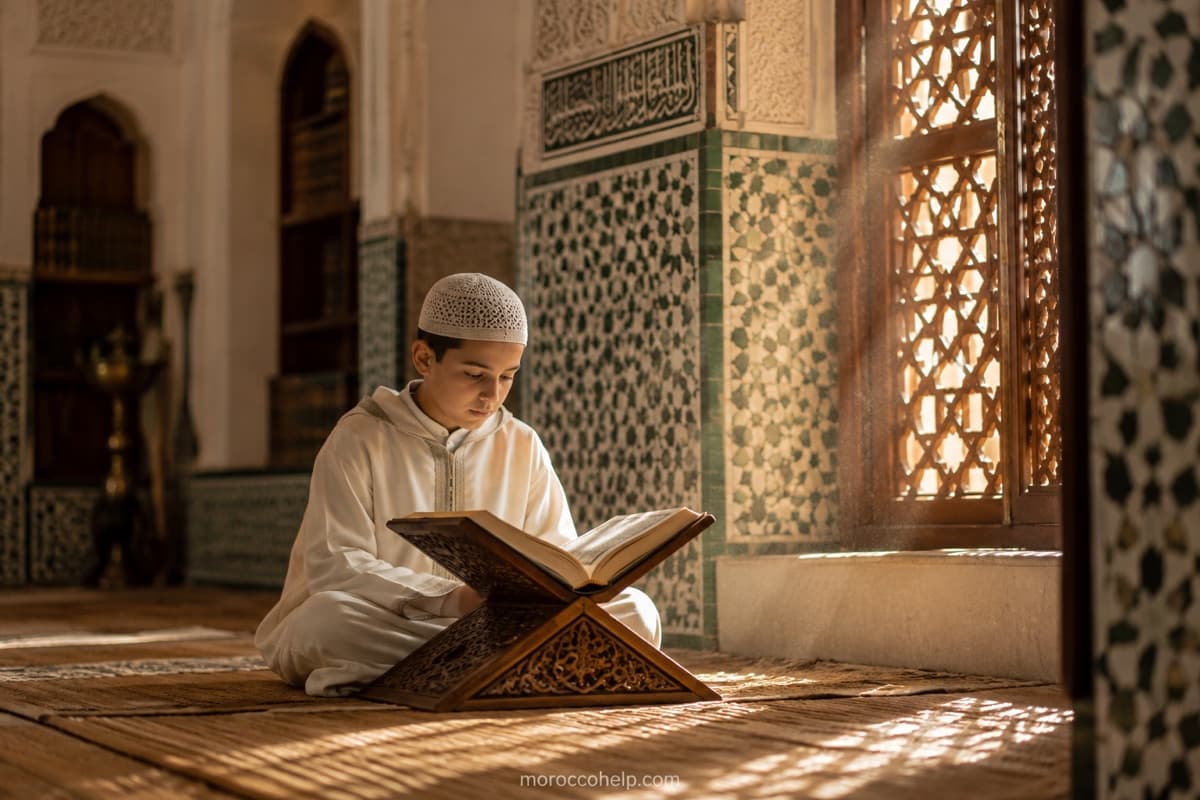
Morocco's mosques are far more than architectural treasures. They are the living hearts of their communities, places where the daily rhythm of prayer shapes life, where children learn the Quran, where scholars teach, and where the faithful find peace. The tradition of building beautiful mosques continues today, with new mosques across Morocco incorporating traditional craft techniques alongside modern engineering.
For visitors and residents alike, taking time to appreciate these mosques, whether through guided tours, Friday prayers, or simply pausing to admire a minaret against the sky, is to connect with a heritage of faith, art, and community that defines Morocco. Each mosque, from the grandest to the humblest neighborhood masjid, stands as a testament to the Moroccan people's enduring love for their religion and their remarkable skill in expressing that love through architecture.
Conclusion
The mosques of Morocco represent a continuous thread of Islamic civilization stretching from the 9th century to the present day. From the scholarly legacy of Al-Qarawiyyin to the oceanic grandeur of the Hassan II Mosque, these places of worship embody the values, artistry, and devotion of the Moroccan people. They remind us that a mosque is never just a building; it is a living expression of a community's relationship with Allah, with knowledge, and with beauty.