The Sun in Islam: A Sign of Allah's Mercy, Power, and Creation
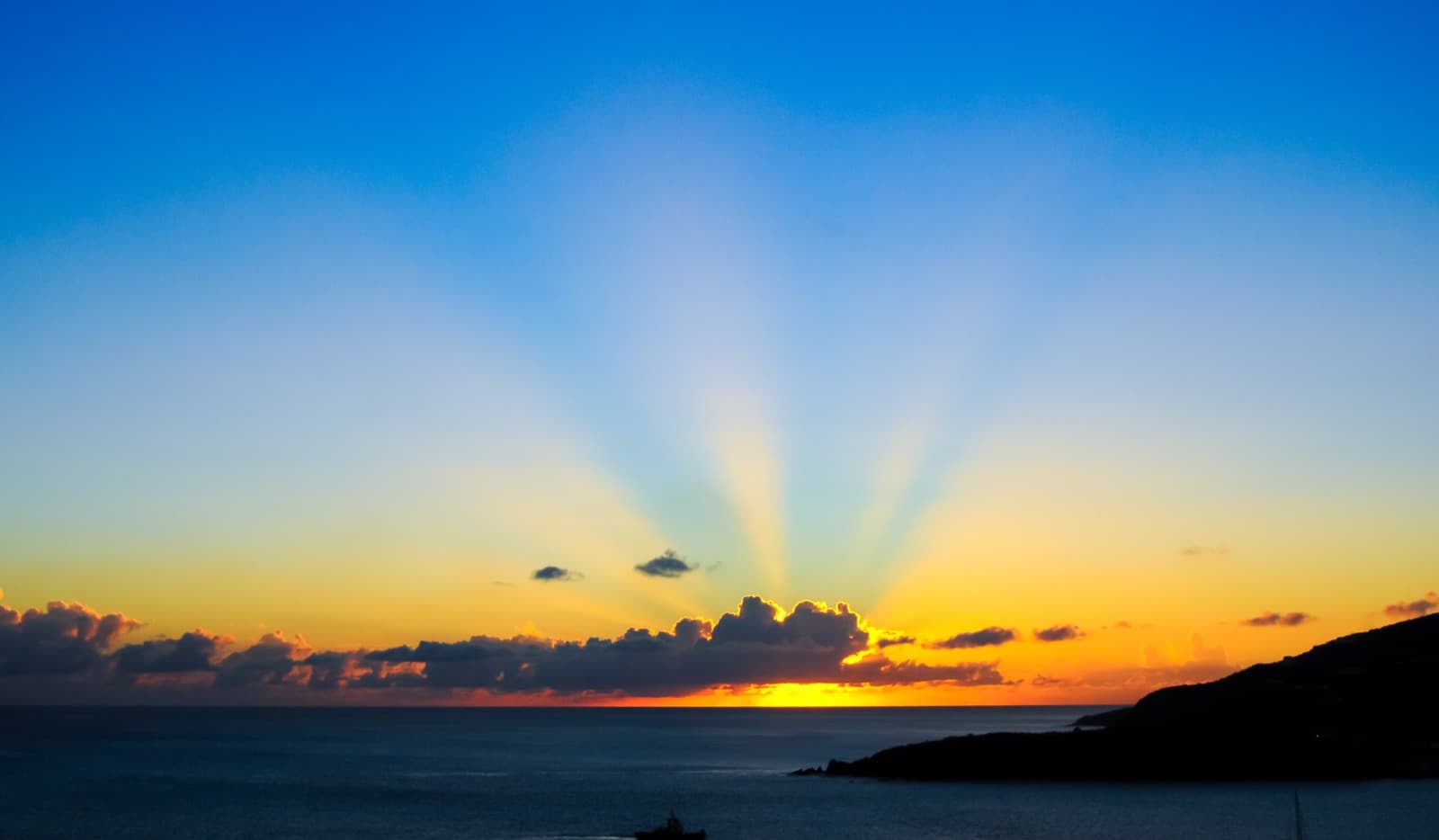
Every morning, before the heat of a Marrakech noon or the blaze of an Ouarzazate afternoon, the sun rises over Morocco - a daily sign so familiar that we can forget it carries a message. In Islam, the sun is not a god to be worshipped, nor a random ball of plasma; it is an ayah, a sign pointing straight to the One who created it. Understanding what the Quran and Sunnah say about the sun deepens both our theology and our gratitude.
The Sun: A Sign (Ayah) of Allah
The Quran opens one of its most powerful chapters with an oath by the sun:
"By the sun and its morning brightness, and by the moon when it follows it, and by the day when it displays it, and by the night when it covers it..." - Quran, Ash-Shams 91:1-4
In Arabic rhetoric, when Allah swears by something, He elevates it as a witness to a profound truth. Here the sun testifies to the order of the cosmos and the One behind it. A few chapters earlier, the Quran summarises the entire cosmic order in a single verse:
"The sun and the moon [move] by precise calculation; and the stars and trees prostrate. And the heaven He raised and imposed the balance." - Quran, Ar-Rahman 55:5-7
The Arabic word husban (calculation) is astonishingly fitting: the sun keeps a course so regular that for centuries humans have set clocks and prayer times by it. Yet that very regularity is the signature of a Regulator, not of chance.
Tawheed: The Sun Is Created, Not Divine
The clearest Quranic teaching on the sun is that it is created, and that worshipping it is shirk - the unforgivable sin if one dies upon it. The Quran tells the story of Prophet Ibrahim (Abraham), who debated his people's idolatry step by step through the night sky:
"When he saw the sun rising, he said, 'This is my lord; this is greater.' But when it set, he said, 'O my people, indeed I am free of that which you associate with Allah. Indeed, I have turned my face toward He who created the heavens and the earth, inclining toward truth, and I am not of the polytheists.'" - Quran, Al-An'am 6:78-79
Ibrahim's method is the method of pure tawheed: anything that sets, that changes, that is overcome by night - anything, in other words, that is created - cannot be the Creator. The sun, for all its glory, is a servant that rises only by permission and sets by command. Worshipping it is to mistake the lamp for the one who lit it.
The Quran elsewhere names the ancient worship of the sun directly - the people of Sheba "prostrated to the sun instead of Allah" (An-Naml 27:24) - and the Prophet Muhammad (peace be upon him) uprooted such practices wherever they appeared.
The Sun Prostrates to Its Lord
In a famous hadith in Sahih Muslim, the Prophet (peace be upon him) asked his companion Abu Dharr at sunset:
"Do you know where the sun goes?" Abu Dharr replied, "Allah and His Messenger know best." He said: "It goes until it prostrates beneath the Throne of Allah, and it seeks permission to rise again, and it is granted permission..." - Muslim
This image is breathtaking. A star more than a million times the volume of the Earth, that pours light upon us each day, is itself a worshipper that bows before its Lord. The hadith continues that near the end of time, permission to rise will be refused - a sign of the approaching Hour. Far from deifying the sun, Islam reveals it as the most obedient of creations.
The Sun Runs a Precise Course
Centuries before modern astronomy spoke of galactic orbits, the Quran described the sun's motion:
"And the sun runs toward a stopping point (mustaqarr) determined for it - that is the decree of the Exalted in Might, the Knowing." - Quran, Ya-Sin 36:38
"It is not allowable for the sun to reach the moon, nor does the night overtake the day, but each, in an orbit, is swimming." - Quran, Ya-Sin 36:40
The Arabic verb tajri (to run, to flow) and the image of celestial bodies "swimming" in their orbits (kullun fi falakin yasbahun) express ordered, purposeful motion - the sun does not wander, it is directed. The believer who reads this at dawn and feels the sun on his face at noon sees not randomness but decree.
When the Sun Hides: Salat al-Kusuf (The Eclipse Prayer)
Because the sun is a sign, its temporary disappearance carries weight. On the day the Prophet's son Ibrahim died, a solar eclipse occurred, and some assumed it was in mourning. The Prophet (peace be upon him) corrected them at once:
"The sun and the moon do not eclipse for the death or life of anyone. When you see an eclipse, remember Allah, say the prayer, and supplicate until it is over." - Bukhari & Muslim
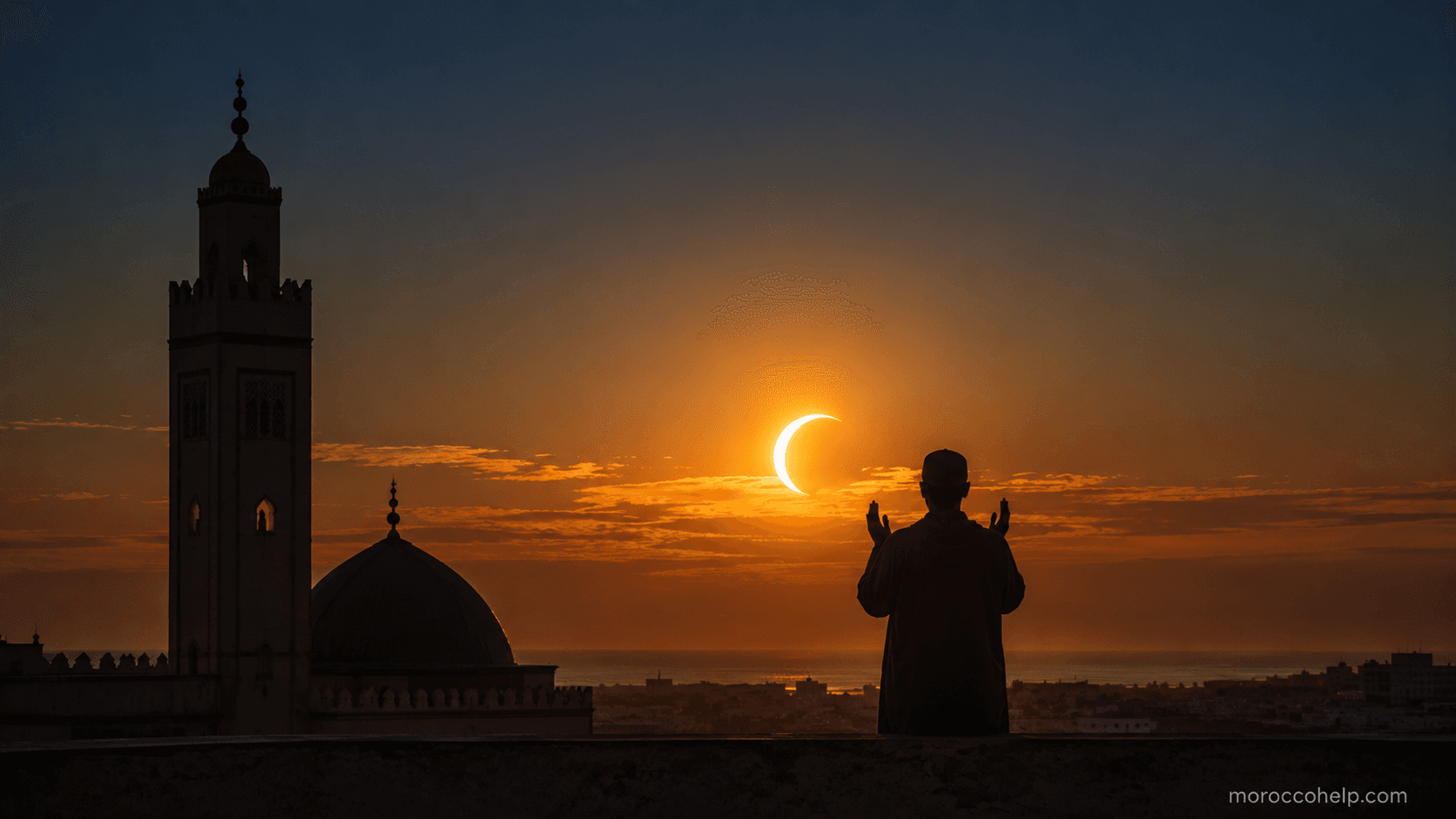
He then led the community in Salat al-Kusuf, the eclipse prayer - two rak'ah with very long recitation and two bowings (ruku') in each rak'ah. In Morocco, the Ministry of Habous and Islamic Affairs announces eclipses in advance and the prayer is performed in mosques across the kingdom, in congregation, with extended Quran and supplication.
The next solar eclipse visible from Morocco will be widely announced; check with your local mosque for the exact time and arrangement.
Morocco: A Land Beneath a Generous Sun
Morocco receives between 2,800 and 3,200 hours of sunshine per year - one of the sunniest countries on Earth. That abundance is a blessing, but it is also a test of stewardship. In summer, the UV index across Moroccan cities frequently climbs to 10–11+ (Extreme), which means the very sign of Allah's mercy can also be a trial for the careless who do not protect themselves.
"And He has made subservient to you whatever is in the heavens and whatever is on the earth - all from Him." - Quran, Al-Jathiyah 45:13
Recognising the sun as a sign does not mean recklessness; it means gratitude - using the shade Allah has provided, hydrating, and guarding the health of the body entrusted to us. You can follow live UV and heat conditions for your city on weather.moroccohelp.com and read our UV index guide.
Lessons: Humility and Gratitude
The sun teaches three things:
- Tawheed. The mightiest thing in our sky is still a servant. How can a servant of God be worshipped?
- Humility. If the sun prostrates beneath the Throne, what should the human heart do?
- Gratitude. Light, warmth, the ripening of crops, the rhythm of prayer - all are gifts carried on a beam of light we did not earn.
Conclusion
In Morocco the sun is both near and daily, yet the Quran asks us to see beyond its blaze to the One who set it running. To face the sun in our daily lives - letting it mark our prayers, warm our land, and remind us of our Lord - without ever confusing the sign for the Signified, is the heart of Islamic monotheism. May Allah make us of those who reflect on His signs.
For your daily prayer times, which themselves follow the sun, visit our prayer-times schedule for Morocco.