Salat al-Kusuf 2026: Why Morocco Did Not Hold the Eclipse Prayer (and What to Do Instead)
When the Moon crossed the Sun on the evening of Wednesday, 12 August 2026, many Moroccan Muslims expected to perform Salat al-Kusuf — the special eclipse prayer established by the Prophet Muhammad ﷺ. Instead, the Ministry of Awqaf and Islamic Affairs issued a clear announcement: the eclipse prayer would not be held in the mosques of the Kingdom. The reason was not indifference to a sign of Allah — it was a precise application of the Maliki school's rulings on the time of the eclipse prayer, which the eclipse's late-afternoon timing placed outside.
This article explains the ruling: why an eclipse after Asr is excluded, what the Maliki mu'tamad says about the valid time, the genuine scholarly difference on the question, and — most importantly — the worship Muslims are asked to perform instead.
The Official Decision
On Monday 10 August 2026, the Ministry of Awqaf and Islamic Affairs announced that, because the solar eclipse would occur from after Asr prayer until just before sunset (Maghrib), Salat al-Kusuf would not be performed. The decision rested on the Supreme Scientific Council (al-Majlis al-'Ilmi al-A'la), the Kingdom's highest religious authority under the Amir al-Mu'minin, and on the established fiqh of the Maliki school that Morocco officially follows.
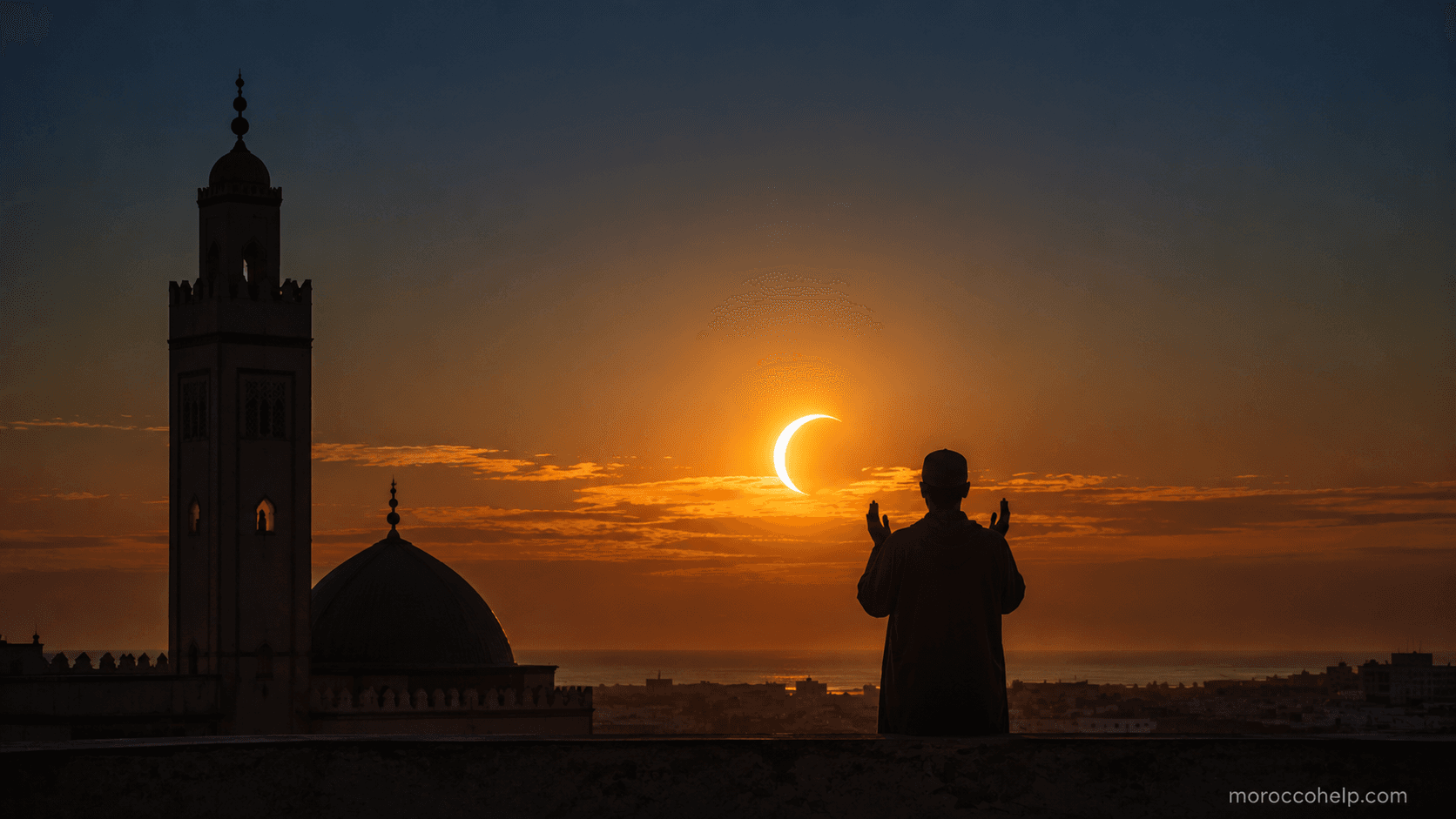
The Ministry framed the decision in a spirit of facilitation (taysīr) — "the religion is ease, not hardship" — and invited Moroccans, during the eclipse, to confine themselves to individual du'ā', dhikr, and istighfār until the phenomenon cleared.
Eclipses in Islam: A Sign, Not an Omen
Before the fiqh, the theology must be clear. In Islam a solar eclipse — kusūf (كسوف) — is one of the signs (āyāt) of Allah, and it is never an omen of anyone's death or life. On the day the Prophet's son Ibrāhīm died, a solar eclipse occurred, and people linked the two. The Prophet ﷺ corrected them at once:
"The sun and the moon do not eclipse for the death or life of anyone. When you see them, remember Allah, say the takbīr, pray, and give charity until it clears." — Bukhari & Muslim
So an eclipse is a call to humility, remembrance, and worship — exactly why the sharī'ah prescribed a special prayer for it. The question this article addresses is purely one of timing: when the eclipse arrives in a disliked time, how do we answer that call?
The Maliki Ruling on the Time of Salat al-Kusuf
This is the heart of the matter. The relied-upon position (mu'tamad) of the Maliki school holds that the time of Salat al-Kusuf runs from the moment voluntary prayers become permitted after sunrise until zawāl (solar noon, just before the Dhuhr prayer). It is not legislated after zawāl until sunset.
The reason is that Salat al-Kusuf is, in the Maliki school, a supererogatory prayer (nāfilah) — a strongly recommended sunnah, not an obligation. And the nawāfil are subject to the times of karāhah (dislike/prohibition), the most relevant of which here is:
From after the Asr prayer until sunset.
Because the 12 August 2026 eclipse unfolded roughly between 18:44 and 20:40 (local WEST) — long after Asr and ending only at Maghrib — it fell squarely inside a disliked time. Performing a nāfilah then is not allowed on the Maliki mu'tamad, so the eclipse prayer could not be established.
[!INFO] The Maliki mu'tamad defines the eclipse-prayer window as from the permission of nāfil (after sunrise) until zawāl. Eclipses in the morning or forenoon fall within it; afternoon and sunset eclipses fall outside it. This is the precise fiqh basis of Morocco's 2026 decision.
The Scholarly Difference: "Prayers With a Cause"
It is important to be honest that other scholars — most notably the Shafi'i school and a number of later scholars — hold a different view. They argue for the principle of "prayers with a cause" (ṣalāt dhāt al-sabab): that certain prayers tied to a specific occasion (the eclipse prayer, the tahiyyat al-masjid greeting-the-mosque prayer, etc.) are exempt from the general prohibition on nāfil in the disliked times.
On this view, Salat al-Kusuf would be valid after Asr, because its specific cause — the eclipse itself — permits it. This is a legitimate, well-known position in the ummah's fiqh heritage.
Morocco, however, follows the Maliki mu'tamad, which does not extend that exemption to Salat al-Kusuf. The Kingdom's religious institutions therefore hold to the position that the eclipse prayer is bound by the disliked-times rule. This is not a rejection of the other view's validity — it is a disciplined adherence to the school the Kingdom has inherited.
What to Do Instead: Worship in a Disliked Time
When Salat al-Kusuf cannot be held because of the time, the eclipse does not pass unmarked. The prophetic guidance points clearly to what the believer should do, and this is precisely what the Ministry of Awqaf recommended for 12 August 2026:
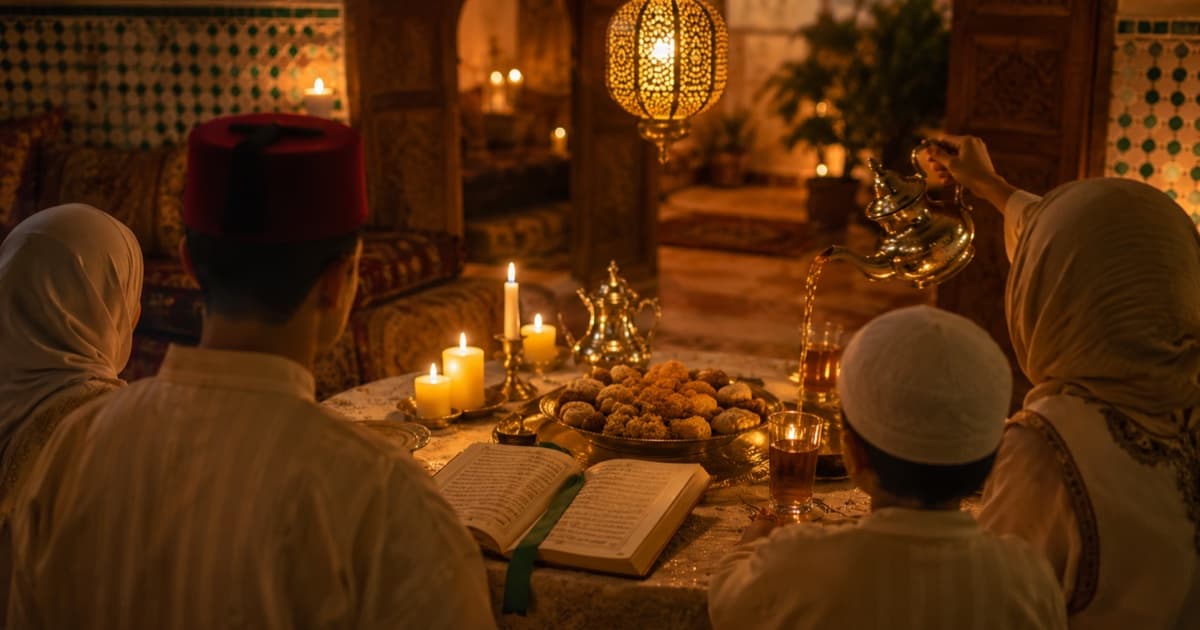
- Du'ā' (supplication). An eclipse is a moment when supplications are especially urged — the Prophet ﷺ called believers to "supplicate until it is over."
- Dhikr (remembrance of Allah). Lā ilāha illā Allāh, Subhān Allāh, Alhamdulillāh, Allāhu Akbar — and the Prophet's specific instruction to "remember Allah."
- Istighfār (seeking forgiveness). Turning back to Allah in repentance as the sky dims is a powerful act of the heart.
- Sadaqah (charity). The hadith explicitly names charity: "...and give charity."
- Reflection (i'tibār). Seeing the eclipse as a sign of Allah's power and majesty — a reminder of the Day of Judgement and of our smallness before the Creator.
These acts are done individually, not as a congregation, when the eclipse is in a disliked time. They need no mosque, no imam, and no preparation — only a heart that turns toward its Lord as the light dims.
How Salat al-Kusuf Is Performed (When the Time Is Valid)
For completeness, and for the eclipses that do fall in a valid time, here is how Salat al-Kusuf is performed — two rak'ah with a distinctive structure of two bowings (rukū') in each rak'ah:
- Make the intention (niyyah) for Salat al-Kusuf.
- First rak'ah: say the opening takbīr, recite al-Fātihah and a long sūrah aloud, then bow (rukū') with a long tasbīh; rise and recite al-Fātihah and another long passage; bow a second time; then prostrate (sujūd) with lengthy prostrations.
- Second rak'ah: repeat the same pattern — two long recitations each followed by its own rukū' — then complete the sujūd, sit for the tashahhud, and give the salām.
- After the prayer, the imam delivers a sermon (khuṭbah) of admonition and reminder.
The entire prayer should last roughly as long as the eclipse itself, with the recitations and bowings drawn out — a tangible expression of awe before the sign of Allah. For the wider Islamic meaning of the sun as a sign, see our companion article The Sun in Islam: A Sign of Allah.
The 2026 Eclipse in Its Astronomical Context
The eclipse of 12 August 2026 was a deep partial eclipse over Morocco — the Moon obscured up to about 93% of the Sun in the north, with the maximum phase around 19:40 local time, ending as the Sun set. For the full scientific, city-by-city, and weather account of the event, see our companion article on the MoroccoHelp weather portal: Sun Meets Moon: The Deep Solar Eclipse Over Morocco.
Looking Ahead: The 2027 Eclipse — a Morning Event
Here is a striking contrast that sharpens the whole ruling. The next major eclipse, the total solar eclipse of 2 August 2027, is a morning event over Morocco — beginning around 07:40 and peaking near 09:45 local time, with totality lasting close to five minutes in the north.
A morning eclipse falls inside the Maliki valid window (after sunrise, before zawāl). So while Salat al-Kusuf was not held in 2026, it is expected to be performed in mosques across the Kingdom in 2027, with the full congregational prayer and sermon — a once-in-a-generation act of worship under a suddenly darkened mid-morning sky.
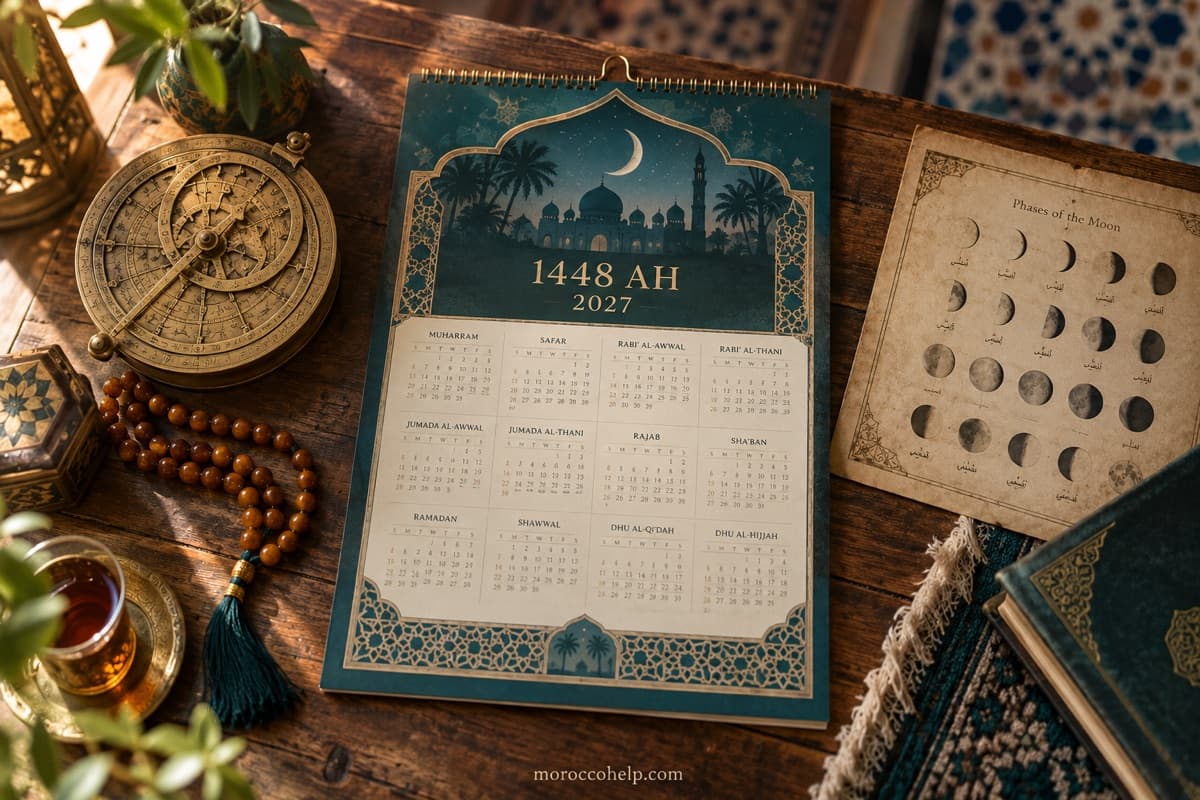
You can track the daily prayer times that frame these rulings on our prayer-times schedule for Morocco, and explore the lunar calendar that governs the Islamic months on the Hijri calendar.
Conclusion
The 2026 eclipse taught Moroccan Muslims a subtle but beautiful lesson in fiqh: that even an act of devotion is ordered by its Lord's rules. Because the eclipse came in a disliked time, the prayer gave way to du'ā', dhikr, and istighfār — and the sign of Allah was met not with less worship, but with the worship most fitting for that hour. And the heavens have already scheduled the next lesson: a morning of totality in 2027, when, God willing, the mosques will fill and Salat al-Kusuf will rise as the Sun goes dark.