Eid al-Fitr 2026 Morocco: Official Date, City Prayer Times & Celebration Guide
Morocco's Ministry of Habous and Islamic Affairs has officially announced that Eid al-Fitr 2026 falls on Friday, March 20, 2026, corresponding to 1 Shawwal 1447 AH. The announcement followed the sighting committee's confirmation that the month of Ramadan 1447 AH completed a full 29 days.
Last updated July 2026 · Source: Ministry of Habous and Islamic Affairs (Kingdom of Morocco). Dates below are based on the official Moroccan naked-eye moon sighting and may differ by one day from Saudi/Umm al-Qura dates.
Official Announcement
The moon sighting committee, convened by the Ministry of Habous on the evening of Thursday, March 19, 2026 (29 Ramadan 1447 AH), confirmed the Shawwal crescent. This established the confirmed sequence of dates:
| Event | Date | Day | Hijri Date |
|---|---|---|---|
| First day of Ramadan 1447 | February 19, 2026 | Thursday | 1 Ramadan 1447 |
| Laylat al-Qadr (most likely) | ~March 17, 2026 | Tuesday | 27 Ramadan 1447 |
| Last day of Ramadan (fasting) | March 19, 2026 | Thursday | 29 Ramadan 1447 |
| Eid al-Fitr (1 Shawwal) | March 20, 2026 | Friday | 1 Shawwal 1447 |
Because Eid fell on a Friday, Moroccan families in 2026 enjoyed an extended holiday weekend, combining the spiritual weight of Eid with the weekly Jumu'ah prayer.
Zakat al-Fitr 2026: Pay Before the Eid Prayer
Eid al-Fitr is inseparable from Zakat al-Fitr (the "charity of fast-breaking"), an obligatory payment that every Muslim, adult and child, free and bondsman, must make before the Eid prayer begins. Its purpose is to purify the fasting person and to ensure that the poor can also celebrate the feast.
- Amount (2026): set by the Supreme Scientific Council at approximately 20 MAD per person in Morocco.
- Form: either the cash equivalent (~20 MAD) or roughly 2.5 kg of the local staple food (wheat, barley, dates, or raisins) per person.
- Who pays: the head of household pays on behalf of every member, including dependents and unborn children.
- When: during Ramadan, ideally in the last two or three days, but it must reach the recipient before the Eid prayer. Paying it late counts as ordinary sadaqah, not Zakat al-Fitr.
Pay through the National Zakat Fund of the Ministry of Habous, accredited associations, or directly to a needy family. Use our Zakat al-Fitr tool to calculate the exact amount for your household.
Eid Prayer Times by City
The Eid prayer is performed after sunrise, approximately 13–15 minutes after Shurooq (sunrise), once the sun has risen the length of a spear above the horizon. It is a recommended (Sunnah Mu'akkadah) prayer of two rak'ahs, prayed in congregation, ideally in a musalla (open prayer ground) or the main mosque of the city.
Below are the estimated Eid prayer times for Friday, March 20, 2026 in major Moroccan cities:
| City | Shurooq (approx.) | Eid Prayer (approx.) |
|---|---|---|
| Casablanca | 6:55 AM | ~7:10 AM |
| Rabat | 6:53 AM | ~7:08 AM |
| Marrakech | 7:00 AM | ~7:15 AM |
| Fes | 6:48 AM | ~7:03 AM |
| Tangier | 6:48 AM | ~7:03 AM |
| Agadir | 7:05 AM | ~7:20 AM |
| Meknes | 6:50 AM | ~7:05 AM |
| Oujda | 6:40 AM | ~6:55 AM |
| Tetouan | 6:50 AM | ~7:05 AM |
| Kenitra | 6:53 AM | ~7:08 AM |
These times are estimates. Confirm the exact hour with your local mosque or our Prayer Times tool, which lists the Shurooq time for every Moroccan city.
How the Eid Prayer Is Performed
The Eid prayer has a distinctive form:
- No adhan and no iqamah, the prayer begins with the opening takbir.
- Extra takbirat, in the first rak'ah the imam says the opening takbir followed by six additional takbirat before reciting Al-Fatihah and a surah. In the second rak'ah, he says five additional takbirat before the recitation (Maliki school, as practiced in Morocco).
- Recitation, the imam typically recites Surah Al-A'la (87) in the first rak'ah and Surah Al-Ghashiyah (88) in the second, following the practice of the Prophet ﷺ.
- The khutbah (sermon), follows the prayer, and listening to it is recommended (unlike the Jumu'ah khutbah, which is obligatory).
Before the prayer, worshipers raise their voices in the Eid takbirat:
"Allahu Akbar, Allahu Akbar, La ilaha illallah, Wallahu Akbar, Allahu Akbar, Wa lillahil hamd."
In Morocco, the takbirat echo from the minarets from the night before (the night of 29 Ramadan) until the imam begins the Eid prayer.
Moroccan Eid al-Fitr Traditions
Eid al-Fitr in Morocco, sometimes called "Eid al-Sghir" (the Small Eid, in contrast to Eid al-Adha / Eid al-Kebir), is a joyful national holiday woven through with distinctive local customs:
The Morning
- Ghusl (ritual bath) and putting on new or best clothes, many Moroccans wear a freshly pressed jellaba or gandora, and children are dressed in new outfits bought specially for the occasion.
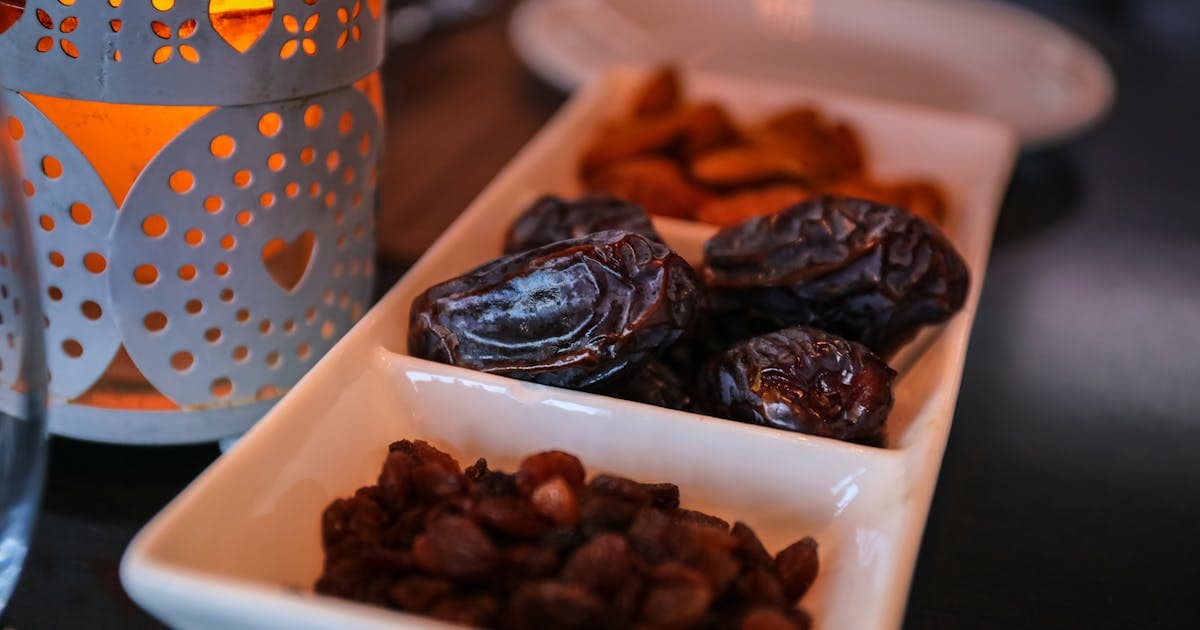
- Eating dates (often the prized Mejhoul variety), the Sunnah is to break the fast of Eid morning with an odd number of dates before going to the prayer.
- Attending the Eid prayer together as a family, the walk to the musalla or grand mosque is itself a festive procession.
The Feast
After the prayer and khutbah, families return home to a table laden with Moroccan sweets prepared during the last days of Ramadan:
- Chebakia, flower-shaped, sesame-coated pastries soaked in honey
- Kaab el Ghzal (Cornes de Gazelle), crescent almond pastries
- Briouats, crisp filled pastries (sweet almond or savory)
- Ghriba, crumbly dome-shaped cookies (coconut, almond, or peanut)
- Baghrir and Msemen, Moroccan pancakes and layered flatbreads with honey and butter
Mint tea (atay) flows freely, and families visit the graves of loved ones in the morning before returning to the celebration, a moment of remembrance amid the joy.
The Afternoon and Beyond
- Family visits (ziyarat), families travel between relatives' homes for two or three days, exchanging gifts and sweets. Children receive Eidiya (cash gifts) from their elders.
- Forgiveness and reconciliation, Eid is the traditional moment to repair broken relationships; Moroccans will travel long distances to reconcile with estranged family.
- Hospitality to neighbors, including non-Muslim neighbors, sharing plates of sweets in a spirit of coexistence that characterizes Moroccan Islam.
What to Do Before Eid al-Fitr
Prepare in the last days of Ramadan so that Eid arrives without stress:
- Calculate and pay your Zakat al-Fitr for every household member before Eid prayer
- Verify your Zakat al-Mal for the year, many Moroccans settle their annual Zakat al-Mal at this time (silver nisab ~7,438 MAD for 2026)
- Complete the six fasts of Shawwal, planning ahead; the Prophet ﷺ said: "Whoever fasts Ramadan then follows it with six days of Shawwal, it is as if he fasted for a lifetime" (Muslim)
- Prepare Eid clothes and clean the home
- Bake or order traditional sweets in advance
- Set aside Eidiya (gift money) for children
- Make a list of relatives to visit and those to reconcile with
Eid al-Fitr vs Eid al-Adha: A Quick Comparison
| Aspect | Eid al-Fitr (1 Shawwal) | Eid al-Adha (10 Dhul-Hijja) |
|---|---|---|
| Meaning | "Festival of Breaking the Fast" | "Festival of Sacrifice" |
| Marks the end of | Ramadan fasting | The Hajj pilgrimage |
| 2026 date (Morocco) | Friday, March 20, 2026 | Wednesday, May 27, 2026 |
| Obligation before | Zakat al-Fitr (~20 MAD/person) | Udhiya (sacrifice of an animal) |
| Duration | 1 day (celebrated 2–3 days) | 4 days (10th–13th Dhul-Hijja) |
| Moroccan name | Eid al-Sghir (the Small Eid) | Eid al-Kebir (the Great Eid) |
For the other Eid, read our Eid al-Adha 2026 Morocco, Official Date & Prayer Times guide.
Frequently Asked Questions
Is Eid al-Fitr a public holiday in Morocco? Yes, Eid al-Fitr is a national public holiday in Morocco. Schools, government offices, and most businesses close. In 2026, because it fell on a Friday, many workplaces closed for a long weekend.
Can I pray Eid at home if I miss the congregation? The Sunnah is to pray in congregation, but if you are unable to attend, you may pray two rak'ahs at home (some scholars hold it is valid individually, while others recommend it only in congregation, the Maliki position leans toward congregation).
What if I forgot to pay Zakat al-Fitr before the prayer? Pay it as soon as you remember. It remains an obligation (a debt you owe), but it is then recorded as general sadaqah rather than the specific Zakat al-Fitr.
Are the Eid prayer times different from Fajr? Yes. Eid prayer is after sunrise, roughly 13–15 minutes after Shurooq, never at Fajr time.
When do the six fasts of Shawwal begin? The day after Eid, from Saturday, March 21, 2026. They can be kept consecutively or spread across the month of Shawwal.
Conclusion
Eid al-Fitr 2026 arrives on Friday, March 20 in Morocco, crowning a month of fasting, prayer, and Quran with gratitude, generosity, and community. Prepare your Zakat al-Fitr in advance, attend the Eid prayer with your family, and let the joy of the day flow into the whole month of Shawwal, beginning with the six recommended fasts.
May Allah accept our fasting and our worship, and grant us many more Eids in health and faith. Eid Mubarak.
Continue Reading
- Ramadan 2026 Guide Morocco, The complete Ramadan companion: schedule, fasting rules, and Moroccan traditions
- Nisab Zakat al-Mal 2026 in Morocco, Has your wealth reached the threshold? Exact figures in MAD
- Islamic Calendar 1447 AH / 2026 Morocco, All Key Dates, Every Moroccan Islamic date for the year in one place
- Eid al-Adha 2026 Morocco, Official Date & Prayer Times, The other Eid, celebrated in May
Use our Prayer Times tool for the exact Shurooq time in your Moroccan city.