Mawlid an-Nabi 2026 in Morocco: Confirmed Date (Tuesday 25 August), Commemoration & Traditions
Each year, as the month of Rabi al-Awwal returns, Morocco turns its heart toward the birth of the Messenger of Allah, Muhammad (peace and blessings be upon him). Mawlid an-Nabi - also called Eid al-Mawlid - is one of the most beloved religious occasions in the Kingdom: a national holiday in which families, mosques, and zawiyas honor the Prophet whose message is, in Allah's own words, "a mercy to the worlds" (Quran, Al-Anbiya 21:107).
For the year 1448 AH, Mawlid falls on 12 Rabi al-Awwal, which corresponds to Tuesday 25 August 2026 in the Gregorian calendar - a date now officially confirmed by the Ministry of Habous and Islamic Affairs following the sighting of the new crescent.
Confirmed. 12 Rabi al-Awwal 1448: Tuesday 25 August 2026. The Ministry of Habous and Islamic Affairs announced on Thursday 13 August 2026 that the Rabi al-Awwal crescent was sighted, making Friday 14 August the first day of Rabi al-Awwal 1448 and Tuesday 25 August the Mawlid - a national public holiday. Source: Ministry of Habous moon-sighting page.
What Is Mawlid an-Nabi?
Mawlid an-Nabi marks the birth of the Prophet Muhammad (peace be upon him) in Mecca, in the Year of the Elephant, generally placed around 570 CE. The widely reported date of his birth is 12 Rabi al-Awwal - the same month, by Allah's wisdom, in which the Hijrah (the migration to Madinah) took place and in which many scholars hold the Prophet's passing also occurred.
For Muslims, the birth of the Prophet is not merely a historical event; it is the arrival of the one through whom Allah completed His message:
"We have not sent you except as a mercy to the worlds." - Quran, Al-Anbiya 21:107
Mawlid is therefore an occasion of gratitude - gratitude for the gift of the Messenger, and a renewed resolve to follow the Sunnah he brought.
How Morocco Confirms the Date of Mawlid
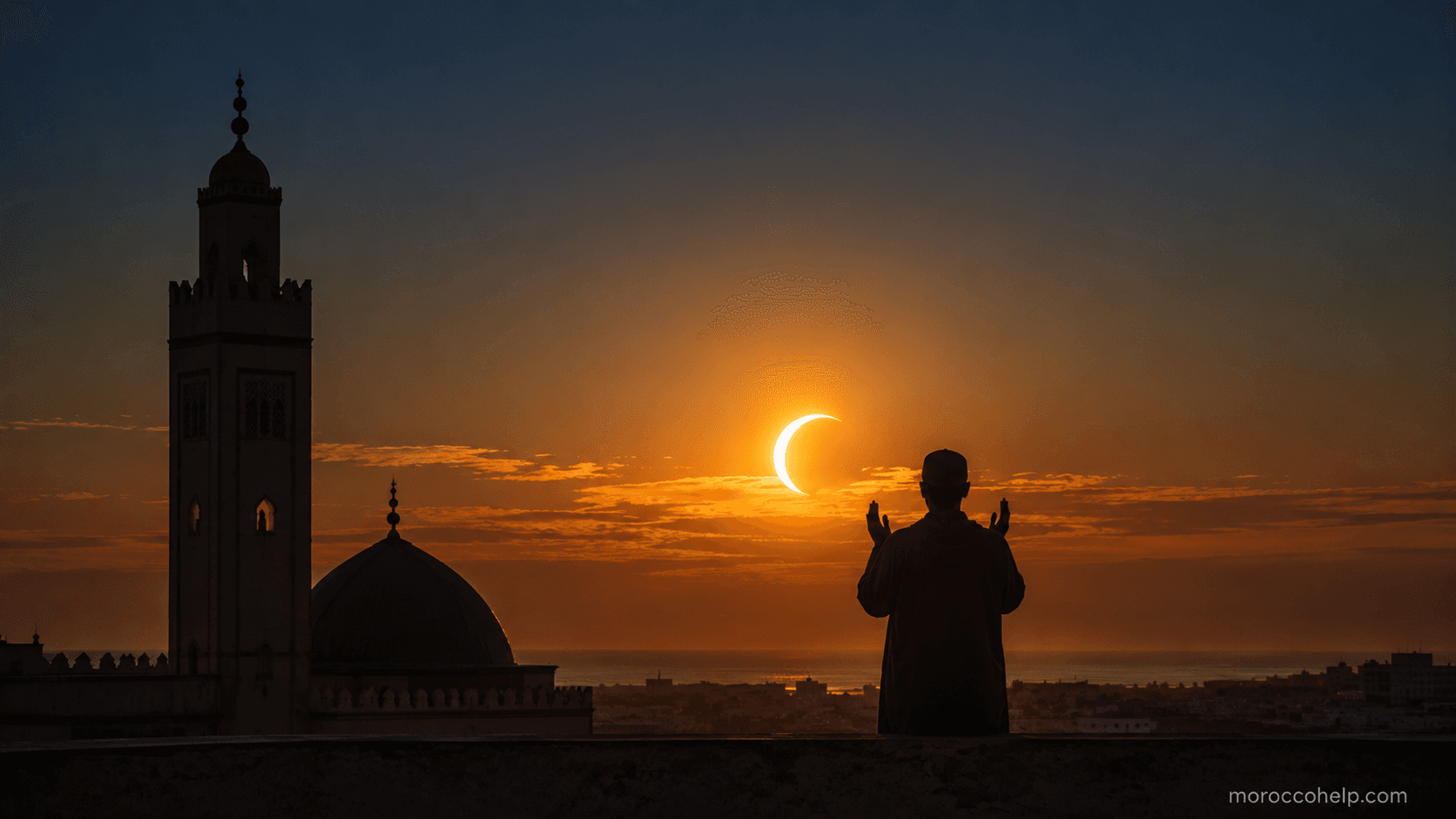
Morocco does not rely on a pre-calculated calendar alone; it follows ru'yat al-hilal, the visual sighting of the new crescent by the naked eye. On the 29th of Safar - the evening of Thursday 13 August 2026 - the Ministry's observers scanned the western horizon just after sunset:
- The crescent of Rabi al-Awwal was sighted → Friday 14 August 2026 became 1 Rabi al-Awwal, and Mawlid falls 12 days later, on Tuesday 25 August.
- Had the crescent not been sighted → Safar would have completed 30 days, Rabi al-Awwal would have begun a day later, and Mawlid would have shifted to 26 August.
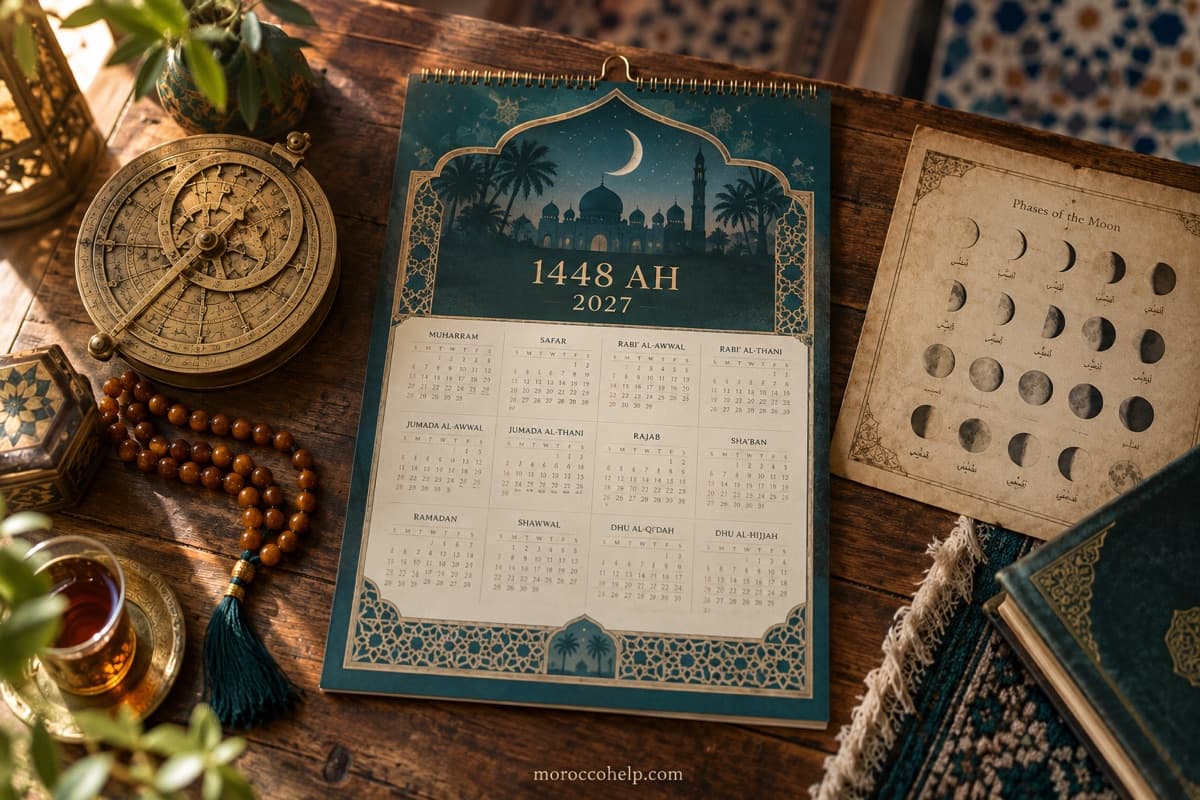
This is why the date carried a ±1 day uncertainty until the sighting was confirmed. With the Ministry's announcement, the 12th is a simple count. You can see the confirmed date on our Hijri calendar, where the event is marked automatically.
A National Holiday in Morocco
Mawlid is an official national holiday in the Kingdom. Schools, public administrations, and most businesses close for the day. The highlight of the official observance is a national ceremony presided over by the King, Commander of the Faithful (Amir al-Mu'minin), in which scholars, ministers, and religious dignitaries from across the Muslim world take part. Religious chants are performed, and the occasion reaffirms Morocco's deep spiritual heritage and the centrality of the Prophet ﷺ in the life of the nation.
How Moroccans Celebrate Mawlid
Moroccan Mawlid is at once devotional and deeply familial. Across the country, the day is marked by:
- Recitation of the Dala'il al-Khayrat - the celebrated collection of prayers upon the Prophet ﷺ compiled by the Moroccan Sufi Sidi Muhammad al-Jazuli (d. 1465). Read in mosques, homes, and zawiyas throughout Rabi al-Awwal, it is one of the most recognizable sounds of the Moroccan Mawlid.
- Chants of praise (madih and inshad) - gatherings in which poets and reciters sing the praises of the Messenger ﷺ, sending abundant blessings (salawat) upon him.
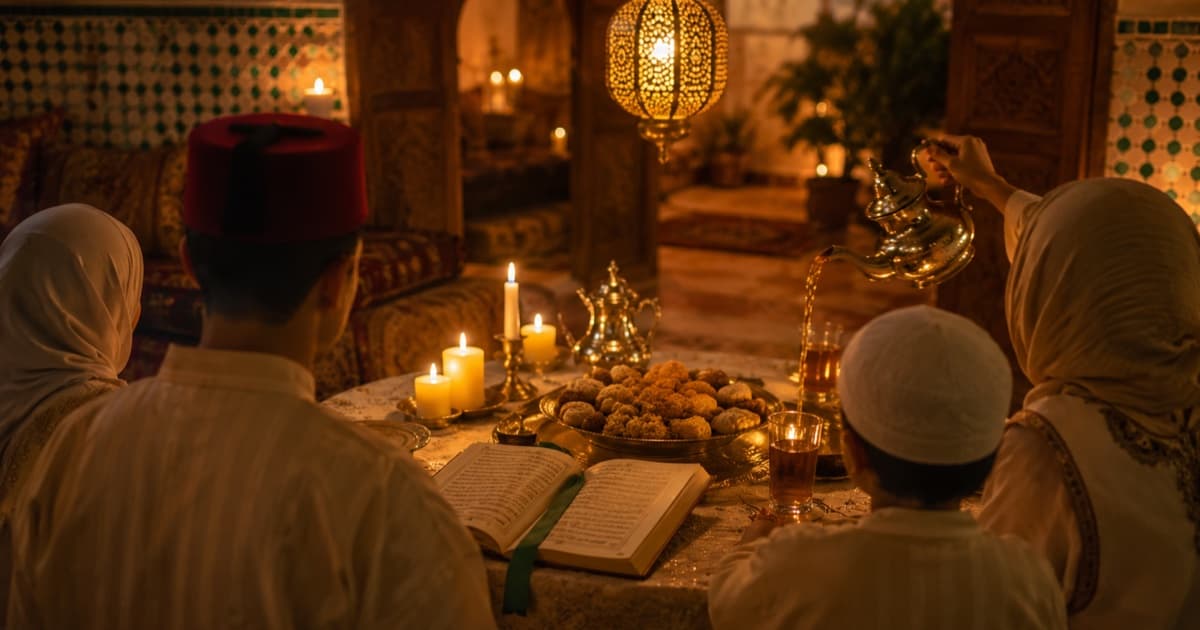
- Traditional sweets and food - families prepare and share special treats such as lam3assal (a confection of sweetmeats and almonds), ghriba, kaab el-ghazal, and other pastries, distributed to neighbors, family, and the poor.
- New clothes for children - a gesture of joy and festivity in many households.
- Charity (sadaqah) - giving to the poor is a central feature, following the principle that every blessing deserves gratitude shared with others.
- Gatherings in mosques and zawiyas - spiritual assemblies, especially in the great zawiyas, which fill with the faithful. The Zawiya Tijaniyya in Fez is among the places where the Mawlid atmosphere is especially vibrant.
The Prophet ﷺ said: "None of you truly believes until I am dearer to him than his father, his child, and all of mankind." - Bukhari & Muslim
The Mawlid Commemoration (Dikra Mawlid Nabawi) 2026: Morocco's Official Observance
In Morocco, two terms coexist for 12 Rabi al-Awwal, and they are often searched together as "dikra Mawlid Nabawi 2026":
- Eid al-Mawlid (Eid Mawlid Nabawi) - عيد المولد النبوي - emphasizes the festive dimension: sweets, new clothes for children, family gatherings, night markets. This is the meaning most common in the street and popular media.
- Dikra Mawlid Nabawi - ذكرى المولد النبوي - literally means "the commemoration of the Prophet's birth" ﷺ. It is the preferred vocabulary of Morocco's Ministry of Habous, the Supreme Council of Ulema, and the royal protocol, because it foregrounds remembrance (dhikr) and the teaching of the Sira rather than the festival itself.
Both terms describe the same day and are used interchangeably in official communiqués. During the Mawlid commemoration 2026 (Tuesday 25 August), Morocco observes two simultaneous layers:
-
The official and spiritual commemoration (dikra):
- A national ceremony presided over by His Majesty the King, Commander of the Faithful (Amir al-Mu'minin), attended by ulema, ministers, ambassadors of Muslim countries, and religious dignitaries.
- Collective recitation of Dala'il al-Khayrat in mosques and zawiyas, alongside sessions of madih (chants of praise) and reading of the Prophetic biography (Sira nabawiyya).
- Religious lectures and talks on the life of the Prophet ﷺ, organized by the Habous ministry and theological universities (al-Qarawiyyin, al-Yusufiya, etc.).
-
The popular festival (eid): traditional sweets (lam3assal, ghriba, gazelle horns), new clothes for children, charity, illuminations, and markets in the medinas.
Why the distinction matters. If you read "Dikra al-Mawlid an-Nabawi" in an official ministry communiqué or in the Moroccan press (MAP, Hespress, Morocco World News), it refers to the very same occasion as the family-facing "Eid Mawlid". The nuance lies in register - official and spiritual on one side, festive and popular on the other - but the date, 12 Rabi al-Awwal 1448 (Tuesday 25 August 2026), is identical.
The Maliki View on Mawlid
Morocco follows the Maliki school of jurisprudence. On the question of Mawlid, the scholarly heritage of the Maliki madhhab offers a balanced and well-documented position:
- The majority of Maliki jurists - including figures such as al-Hattab and Ibn 'Abbad al-Rundi - held that commemorating the birth of the Prophet ﷺ, gathering to recite the Quran and send blessings upon him, and expressing love for him are permissible and commendable acts. Some even considered fasting the day as honoring a day of blessing, while others regarded fasting on it as disliked (makruh) precisely because it resembles a day of Eid.
- At the same time, scholars such as Ibn al-Hajj al-'Abdari (a Maliki from Fez) cautioned against excess and against introducing into the occasion anything contrary to the Sunnah - innovations, intermingling, or practices that distract from the meaning of the day.
The honest summary is this: the Maliki tradition broadly welcomes honoring the birth of the Messenger ﷺ as an expression of love and gratitude, while insisting that the celebration remain within the bounds of the Shariah and centered on following his Sunnah. The day is not an innovation of belief; it is a renewed attachment to the one Allah sent as a mercy.
The True Celebration: Following the Prophet ﷺ
Whatever the form of the celebration, the heart of Mawlid is the renewal of one's bond with the Messenger of Allah. Allah ties love of Himself to following the Prophet:
"Say: If you love Allah, then follow me; Allah will love you and forgive you your sins." - Quran, Al Imran 3:31
The best way to honor the Prophet's birth is therefore to learn his Sunnah, revive his manners, send abundant blessings upon him, and follow his guidance in worship, family, business, and character. As one of the early Muslims said: "Whoever loves the Prophet has followed him; and whoever follows him will be with him in Paradise."
Conclusion
Mawlid an-Nabi 1448 falls, Allah willing, on Tuesday 25 August 2026 in Morocco, as officially confirmed by the Ministry of Habous after the crescent sighting of 13 August. Whether your home fills with the recitation of Dala'il al-Khayrat, the sharing of sweets, or quiet reflection on the life of the Messenger ﷺ, may the occasion renew in us the love of the Prophet and the determination to walk in his footsteps.
For the confirmed Hijri date and the full Islamic calendar, visit our Hijri calendar, and for your daily worship around this blessed season, see our prayer-times schedule for Morocco. May Allah's peace and blessings be upon Muhammad, his family, and his companions.