Traveling During Eid Al-Adha in Morocco: Prayer Rules, Logistics & City Guide
Eid al-Adha triggers one of the largest internal migrations in Morocco every year. Millions travel from cities to family homes in smaller towns and rural areas, creating a massive movement across the country in the days before Eid al-Kebir.
Whether you're driving from Casablanca to your family in the Rif, flying from Europe back to Morocco, or simply navigating a different city during the holiday, this guide covers everything you need, from prayer rulings to traffic tips.
For the spiritual and cultural significance of the holiday, see our complete Eid al-Adha guide. For practical sacrifice preparation, see our qurbani checklist.
Prayer Rules for Travelers During Eid
Can I Shorten Prayers While Traveling?
Yes. A musafir (traveler) who has traveled approximately 81 km or more from their home city has the concession to:
- Shorten the four-rak'ah prayers (Dhuhr, Asr, Isha) to two rak'ahs
- Combine Dhuhr with Asr, and Maghrib with Isha (either at the time of the earlier or later prayer)
This concession applies during the journey and while staying at your destination for less than four days (according to the Maliki school followed in Morocco). After four days of intending to stay, you pray in full.
For detailed traveler prayer rules, see our comprehensive Travel Prayer Rules guide.
Does the Eid Prayer Change for Travelers?
The Eid prayer is two rak'ahs regardless, it is not shortened because it's already two rak'ahs. However, scholars differ on whether it is obligatory for travelers:
- The majority hold that the traveler is not obligated to attend the Eid prayer but should if possible
- If you arrive at your destination before Eid morning, attend the local Eid prayer
- If you're on the road during Eid morning, you may pray it upon arrival
Can I Combine Prayers During My Road Trip?
Yes. When actively traveling (not yet settled at your destination), you may combine:
- Dhuhr + Asr at the time of either
- Maghrib + Isha at the time of either
This is especially useful during long drives. Check prayer times for your route with our Prayer Times tool.
Eid Prayer Locations in Major Moroccan Cities
Each city has its main musallas (open-air prayer grounds) and major mosques for the Eid prayer. The prayer is typically held 15-30 minutes after sunrise.
Casablanca
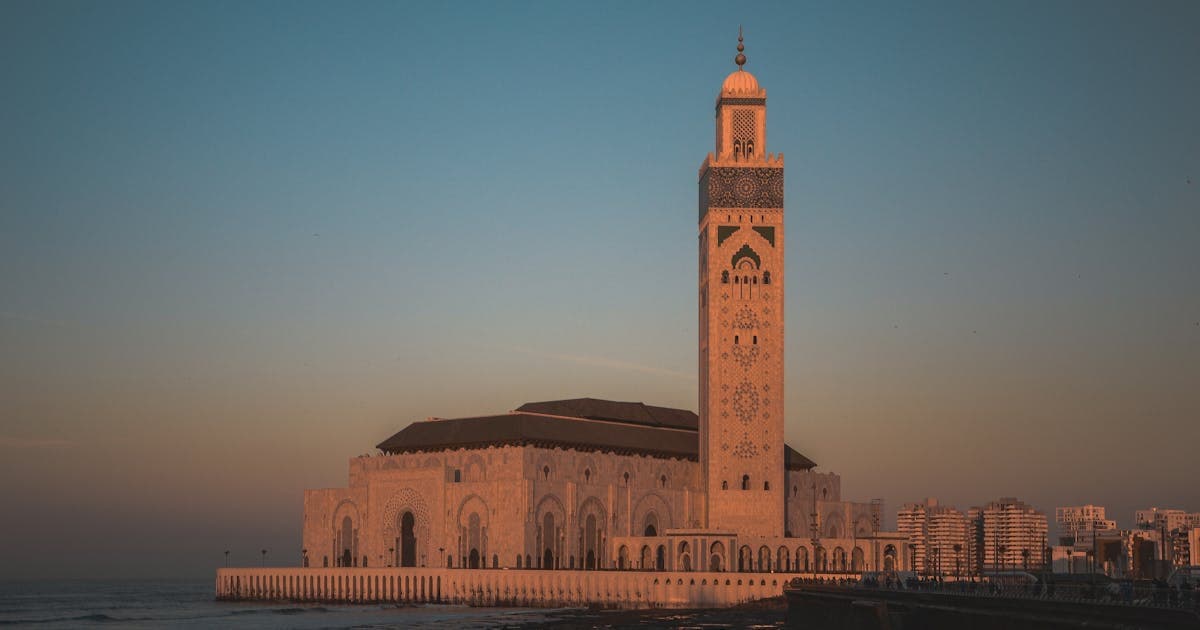
- Hassan II Mosque: The most iconic venue, the esplanade accommodates tens of thousands
- Multiple musallas: Municipal prayer grounds set up in neighborhoods across the city
- Eid prayer is typically around 7:00-7:30 AM (check exact time via Prayer Times)
Rabat
- Assunna Mosque and Mohammed V Mosque: Major congregational venues
- Agdal musalla and neighborhood prayer grounds
- The King traditionally leads the Eid prayer at a designated royal mosque
Fes
- Qarawiyyin Mosque: Historic venue in the medina
- Large musallas in Ville Nouvelle and surrounding neighborhoods
- The ancient city fills with takbirat echoing through the narrow streets
Marrakech
- Koutoubia Mosque: The landmark mosque hosts a large congregation
- Open-air musallas near the Koutoubia gardens and in outlying neighborhoods
- Marrakech's Eid celebrations are particularly vibrant, with the Bilmawen/Boujloud festival
Tangier
- Grand Mosque of Tangier and surrounding musallas
- Cap Spartel area: Some families pray outdoors with ocean views
- Northern Morocco often has slightly different prayer times, verify with Prayer Times
Agadir
- Mohammed V Mosque and municipal musallas
- The Souss region has its own distinct Eid traditions, including Bilmawen celebrations
Check the exact Eid prayer time for any Moroccan city with our Prayer Times tool.
Road Travel Tips for Eid Al-Adha
Peak Traffic Windows
The heaviest traffic occurs:
- 2-3 days before Eid: Exodus from major cities (Friday-Sunday if Eid falls mid-week)
- The day after Eid: Return traffic begins
- 2-3 days after Eid: Peak return to cities
Autoroute (Highway) Strategy
- Leave very early (before 5 AM) or very late (after 10 PM) to avoid peak hours
- The Casablanca–Marrakech, Casablanca–Fes, and Rabat–Tangier corridors are the most congested
- Fuel up the day before departing, gas stations along the autoroute have long queues during Eid
- Toll booths (péages) create bottlenecks, have exact change or a Jawaz pass ready
- Check ADM (Autoroutes du Maroc) traffic updates before departing
Traveling with Livestock
Many families transport their sheep by car, pickup truck, or on roof racks:
- Ensure the animal has adequate ventilation
- Secure it properly to prevent injury
- Take breaks for water (for the animal)
- Be aware that police checkpoints may check for animal health documentation near Eid
- In some regions, temporary animal transport permits are required
Safety Reminders
- Drive defensively, roads are crowded with inexperienced holiday drivers
- Rest every 2 hours on long journeys
- Carry water, snacks, and a basic first-aid kit
- Keep your phone charged for navigation and emergency contacts
Performing Qurbani Away from Home
The Ruling on Traveling and Qurbani
Scholars differ on whether a traveler is obligated to perform qurbani:
- Hanafi school: Qurbani is only obligatory on a resident (muqim). A traveler in the legal sense is exempt.
- Maliki school (followed in Morocco): Qurbani is Sunnah Mu'akkadah for all who can afford it, regardless of travel status.
In practice, most Moroccan families who travel for Eid perform the sacrifice at their destination, typically the family home. This is perfectly valid.
Proxy Sacrifice
If you cannot perform the sacrifice yourself (because you're traveling, abroad, or at a location where it's not practical):
- You may appoint someone (wakeel) to perform the sacrifice on your behalf
- The wakeel says "Bismillah, Allahu Akbar" and mentions your name
- Many Moroccan families coordinate this: one relative performs multiple sacrifices for the extended family
See more qurbani rulings in our FAQ.
Finding Qibla and Prayer Spaces on the Road
Roadside Prayer
Morocco's highways have rest areas every 30-50 km along the autoroute. Many include small mosques or at least a designated prayer area. However, if you need to pray and there's no facility:
- Pull safely off the road
- Use our Qibla Finder on your phone to determine the direction
- Any clean space is acceptable for prayer, lay a mat or clean cloth
- During Eid, many roadside areas have informal congregations
Mosque Locator Tips
In towns along your route:
- Listen for the adhan (call to prayer), follow the sound
- Ask locals, they'll direct you to the nearest mosque
- Major rest stops on the autoroute (like those near Settat, Khouribga, and Beni Mellal) have purpose-built mosques
See also our guide on finding Qibla direction in Morocco and general Qibla direction from Europe for those traveling from abroad.
Accommodation and Restaurant Considerations
Hotel and Riad Bookings
- Book early, Eid al-Adha is a peak travel season and accommodation fills up
- Some riads and hotels may have policies about performing the sacrifice on premises, check in advance
- In rural areas, family stays are the norm; formal accommodation may be limited
Restaurant Closures
- Many restaurants close on the morning of Eid, staff participate in the prayer and sacrifice
- From the afternoon of Eid day, some reopen, but options are limited
- Street food and cafés tend to operate more normally
- Bring snacks and water for the journey, don't rely on finding food during Eid morning
Returning Home: Post-Eid Travel and Ayyam al-Tashriq
Continue the Takbirat
The takbirat of Eid continue from Fajr of the 9th of Dhul Hijja until Asr of the 13th. If you're traveling during these days:
- Continue saying the takbirat after each prayer, even while on the road
- The formula: اللَّهُ أَكْبَرُ، اللَّهُ أَكْبَرُ، لَا إِلَهَ إِلَّا اللَّهُ، وَاللَّهُ أَكْبَرُ، اللَّهُ أَكْبَرُ، وَلِلَّهِ الْحَمْدُ
The Three Days of Tashriq
The 11th, 12th, and 13th of Dhul Hijja are the Ayyam al-Tashriq, days of eating, drinking, and remembering Allah. These are also valid days for performing the qurbani if you haven't done so yet.
Return Traffic
Plan your return trip to avoid peak congestion:
- Best times to return: Very early morning (before 6 AM) or late evening
- The 12th or 13th of Dhul Hijja is typically less congested than the 11th
- Monitor traffic updates via radio (Medi1, 2M) or the ADM app
- Consider stopping at a rest area for Dhuhr/Asr if the journey is long
Quick Reference for Eid Travelers
| Need | Tool |
|---|---|
| Prayer times in any Moroccan city | Prayer Times |
| Qibla direction anywhere | Qibla Finder |
| Islamic calendar dates | Hijri Calendar |
| Traveler prayer rules | Travel Prayer Rules |
| Eid prayer guide and takbirat | Eid al-Adha Guide |
| Qurbani rules and FAQ | FAQ |
| Complete prayer times guide | Prayer Times Guide |
Travel safely and may Allah accept your worship this blessed Eid. Use our Prayer Times, Qibla Finder, and Hijri Calendar tools throughout your journey.