Islamic Art and Calligraphy in Morocco: A Living Heritage of Faith and Beauty
Moroccan Islamic art is not confined to museums, it is a living tradition that fills mosques, homes, madrasas, and public spaces across the kingdom. For over 1,200 years, Moroccan artisans have expressed their devotion to Allah through the creation of objects and spaces of extraordinary beauty, following the Islamic principle that beauty in creation reflects the beauty of the Creator.
What makes Moroccan Islamic art distinctive is its synthesis of Amazigh (Berber) heritage, Arab-Islamic principles, and Andalusian refinement, a fusion that produces a visual language instantly recognizable as Moroccan yet deeply rooted in universal Islamic aesthetics.
The Principles of Islamic Art
Islamic art is guided by several foundational principles that distinguish it from other artistic traditions:
1. Aniconism, The Absence of Figural Imagery
Islamic art traditionally avoids the depiction of living beings in religious contexts, based on the understanding that only Allah creates life. Instead, Islamic artists developed an unparalleled vocabulary of geometric patterns, vegetal motifs, and calligraphy that express spiritual truths through abstraction.
2. Tawhid, Divine Unity Reflected in Design
The intricate geometric patterns of Islamic art reflect the concept of tawhid (divine unity). A single geometric principle generates infinite variations, mirroring the Islamic understanding that all of creation flows from One Source. The repeating patterns suggest the infinite nature of Allah, they have no beginning and no end.
3. The Primacy of Calligraphy
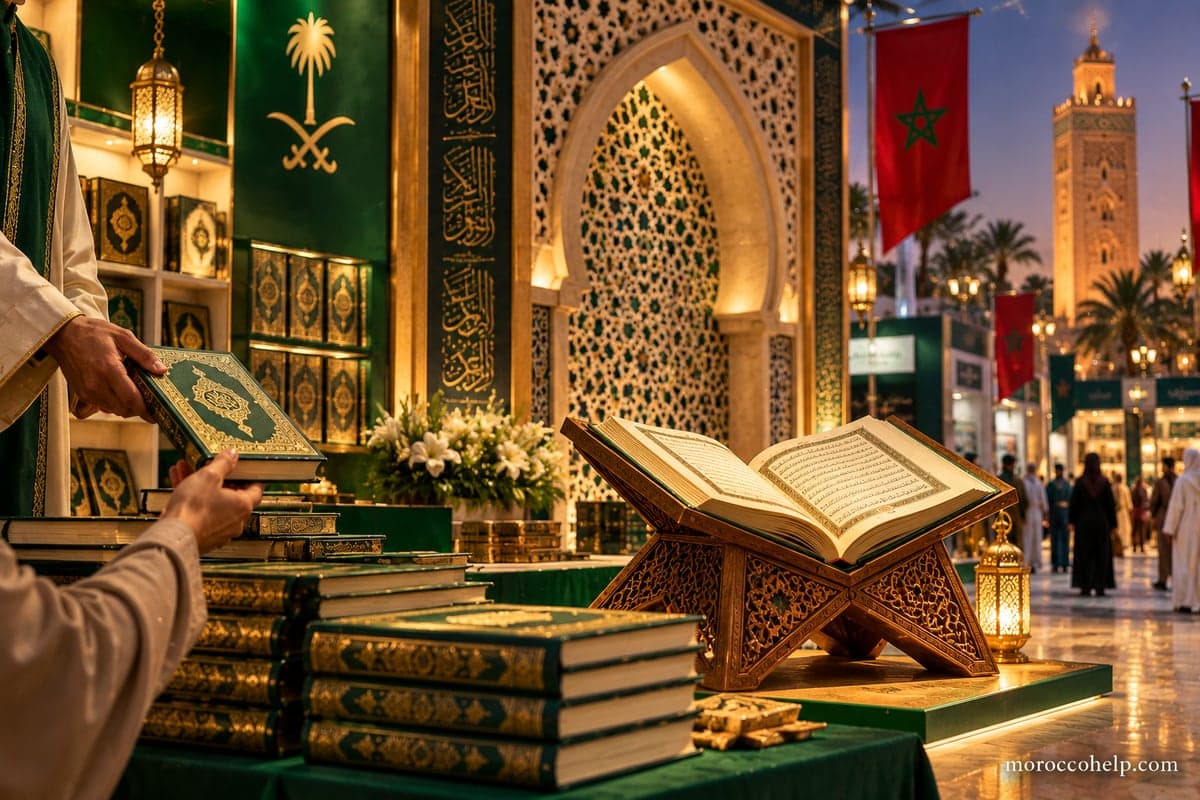
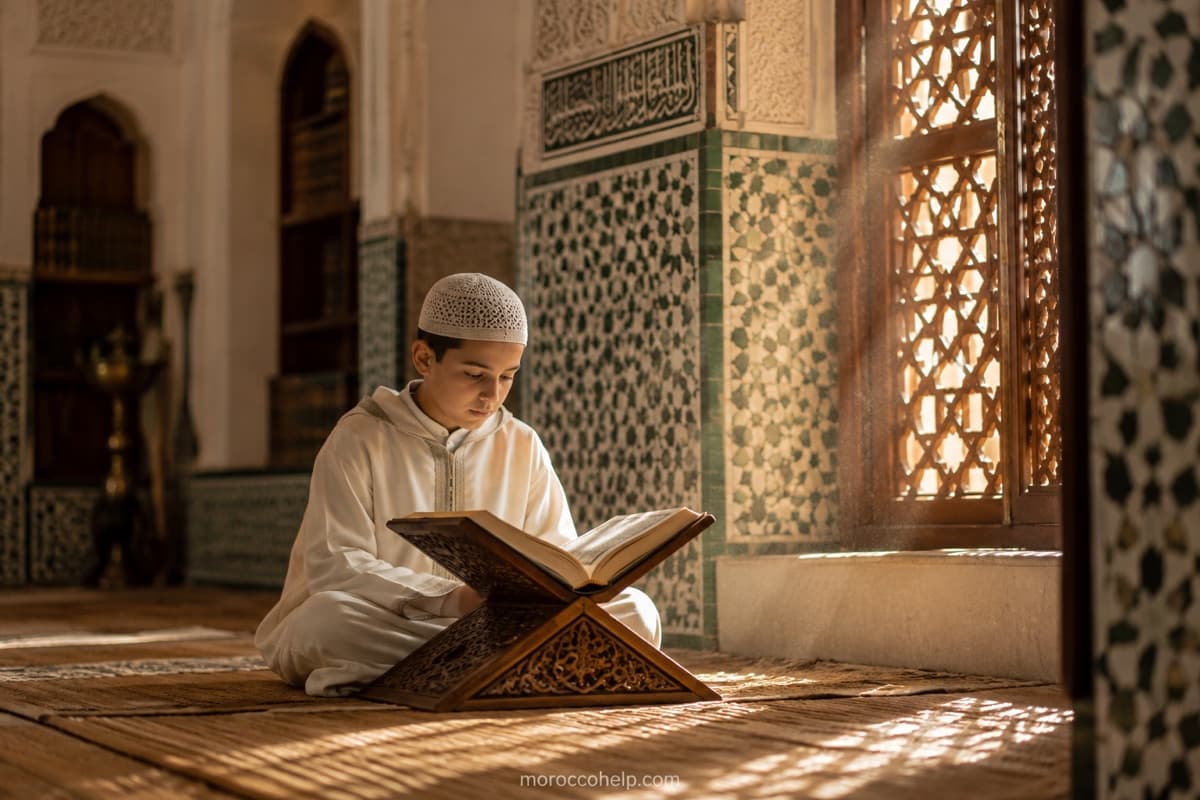
In Islam, the Quran is the literal Word of Allah, and the art of writing is therefore one of the most honored forms of artistic expression. Arabic calligraphy holds a status in Islamic civilization comparable to that of representational art in Western tradition, it is the supreme visual art form.
Zellige: The Crown Jewel of Moroccan Art
Zellige (زليج) is the Moroccan art of geometric mosaic tilework, and it is perhaps the most iconic element of Moroccan Islamic art. Each piece is hand-cut from enameled terracotta tiles and assembled into complex geometric patterns without the use of any drawing or template, the artisan works from memory and mathematical precision.
How Zellige Is Made
- Clay preparation: Fine clay from Fez or Meknes is mixed with water and shaped into square tiles
- Drying and firing: Tiles are sun-dried and then fired in kilns at high temperatures
- Enameling: The surface is coated with colored enamel made from natural minerals
- Second firing: The enameled tiles are fired again to set the glaze
- Hand-cutting: Master craftsmen (maalems) cut each tile into the precise shape needed using a hammer and hardy chisel, no machines are used
- Assembly: The individual pieces are laid face-down and joined with plaster to create the final pattern
Common Zellige Patterns
| Pattern | Meaning | Usage |
|---|---|---|
| Star and cross (Najma) | Unity and interconnection | Floors, walls, fountains |
| Octagon | Paradise and cosmic order | Mihrab surrounds, courtyards |
| Hexagon | Harmony and balance | Wall panels, table tops |
| Chevron | Movement and flow | Border designs |
| Scalloped | Waves and water | Fountains, pool surrounds |
Colors and Their Symbolism
- Blue (cobalt): The heavens, the infinite, divine protection
- Green (copper oxide): Paradise, the Prophet Muhammad (PBUH), Islam itself
- White (tin oxide): Purity, faith, peace
- Yellow (iron): Light, knowledge, warmth
- Red (manganese): Earth, life, vitality
- Black: The void, the unknown, the mystery of Allah
Arabic Calligraphy in Morocco
The Scripts of Moroccan Calligraphy
Moroccan calligraphers traditionally work with several scripts, each suited to different purposes:
Maghribi Script
The Maghribi (or Moroccan Andalusian) script is the distinctive calligraphic style of the western Islamic world. Characterized by its rounded, flowing letters and pronounced curves, it differs significantly from the Eastern Arabic scripts (Naskh, Thuluth) used in the Middle East. Maghribi script has been used in Morocco for Quranic manuscripts, official documents, and architectural inscriptions for over a millennium.
Kufic Script
The angular Kufic script is used primarily for monumental inscriptions on mosques and madrasas. Its geometric forms complement the overall design vocabulary of Moroccan architecture.
Thuluth and Naskh
These more standard Arabic scripts are used alongside Maghribi in contemporary Moroccan calligraphy, especially for Quranic verses and decorative panels.
Where to See Calligraphy in Morocco
| Location | Type | Description |
|---|---|---|
| Hassan II Mosque, Casablanca | Monumental | Quranic verses in stone and stucco |
| Al-Qarawiyyin, Fez | Manuscript | Ancient Quranic manuscripts in Maghribi script |
| Bou Inania Madrasa, Fez | Architectural | Carved stucco calligraphy on courtyard walls |
| Ben Youssef Madrasa, Marrakech | Architectural | Cedar and stucco Quranic inscriptions |
| Royal Palace gates, various cities | Monumental | Quranic verses in bronze and tile |
Carved Plaster (Tadelakt and Gebs)
Gebs (جبص), carved and sculpted plaster, is a defining feature of Moroccan interior architecture. Artisans apply layers of fine plaster to walls and then carve intricate patterns while the material is still semi-soft, creating deep relief designs that combine geometric precision with floral motifs.
The carved plaster typically frames doorways, surrounds windows, and decorates the upper portions of walls below the ceiling. The most elaborate examples feature Quranic verses rendered in relief calligraphy surrounded by vegetal arabesques.
Painted and Carved Cedar Wood
The Atlas cedar (Cedrus atlantica) of Morocco has been the material of choice for master woodworkers for centuries. Moroccan mosques, madrasas, and palaces feature:
- Carved cedar ceilings: Geometric patterns and calligraphy carved into massive cedar beams
- Painted panels: Cedar panels painted with intricate floral and geometric designs in vibrant colors
- Minbar (pulpit): The minbar of the Kutubiyya Mosque in Marrakech, considered one of the finest examples of Islamic woodwork, was crafted in Cordoba and shipped to Morocco in the 12th century
The cedar work in the Bou Inania Madrasa in Fez and the Ben Youssef Madrasa in Marrakech represents the pinnacle of this tradition, entire rooms where every surface is carved with patterns of extraordinary complexity and beauty.
The Art of the Moroccan Mihrab
The mihrab (prayer niche indicating the direction of Mecca) is the focal point of any mosque, and Moroccan artisans have elevated its decoration to the highest level. The mihrabs of Morocco's great mosques typically combine:
- Zellige tilework in geometric patterns
- Carved stucco with Quranic calligraphy
- Marble columns framing the niche
- Painted cedar in the hood of the arch
- Gold leaf accents in some royal mosques
The mihrab of the Koutoubia Mosque and the Hassan II Mosque are among the finest examples in the Islamic world.
Contemporary Moroccan Islamic Art
The tradition of Islamic art in Morocco is not frozen in time. Contemporary artisans and artists continue to innovate within the tradition:
- New zellige designs incorporate modern color palettes while maintaining traditional geometric principles
- Calligraphic artists like those exhibited at the Maison de la Photographie in Marrakech blend traditional scripts with contemporary artistic expression
- The Hassan II Mosque (completed 1993) demonstrates that traditional Moroccan crafts, zellige, carved plaster, painted cedar, can be executed at the highest level using modern engineering
- Islamic art schools in Fez, Marrakech, and Rabat train new generations of artisans in traditional techniques
The Artisan Workshops of Fez
The city of Fez remains the epicenter of Moroccan Islamic art. The Fez medina contains hundreds of workshops where artisans practice their crafts using techniques passed down through families for generations:
- Zellige workshops in the Bab Ftouh quarter
- Carved plaster ateliers near the Al-Qarawiyyin
- Cedar workshops in the Seffarine quarter
- Calligraphy studios producing Quranic manuscripts and architectural inscriptions
Many of these workshops accept visitors, offering a unique opportunity to see master artisans at work.
Conclusion: Art as Worship
In the Moroccan Islamic tradition, art is not separate from faith, it is an expression of it. The artisan who cuts zellige tiles, the calligrapher who inscribes the name of Allah, and the woodcarver who shapes cedar into geometric perfection all understand their work as a form of worship. The beauty they create is an offering to the Creator and a gift to the community.
As the Moroccan proverb says: "He who beautifies the house of Allah beautifies his own heart."
Continue Reading
- Famous Mosques in Morocco: History and Architecture, The architectural masterpieces that showcase Moroccan Islamic art
- Morocco's Islamic Heritage: Zawiyas and Sufi Traditions, The spiritual traditions behind the art
- Understanding the Islamic Months, The calendar that frames Morocco's artistic and religious seasons